
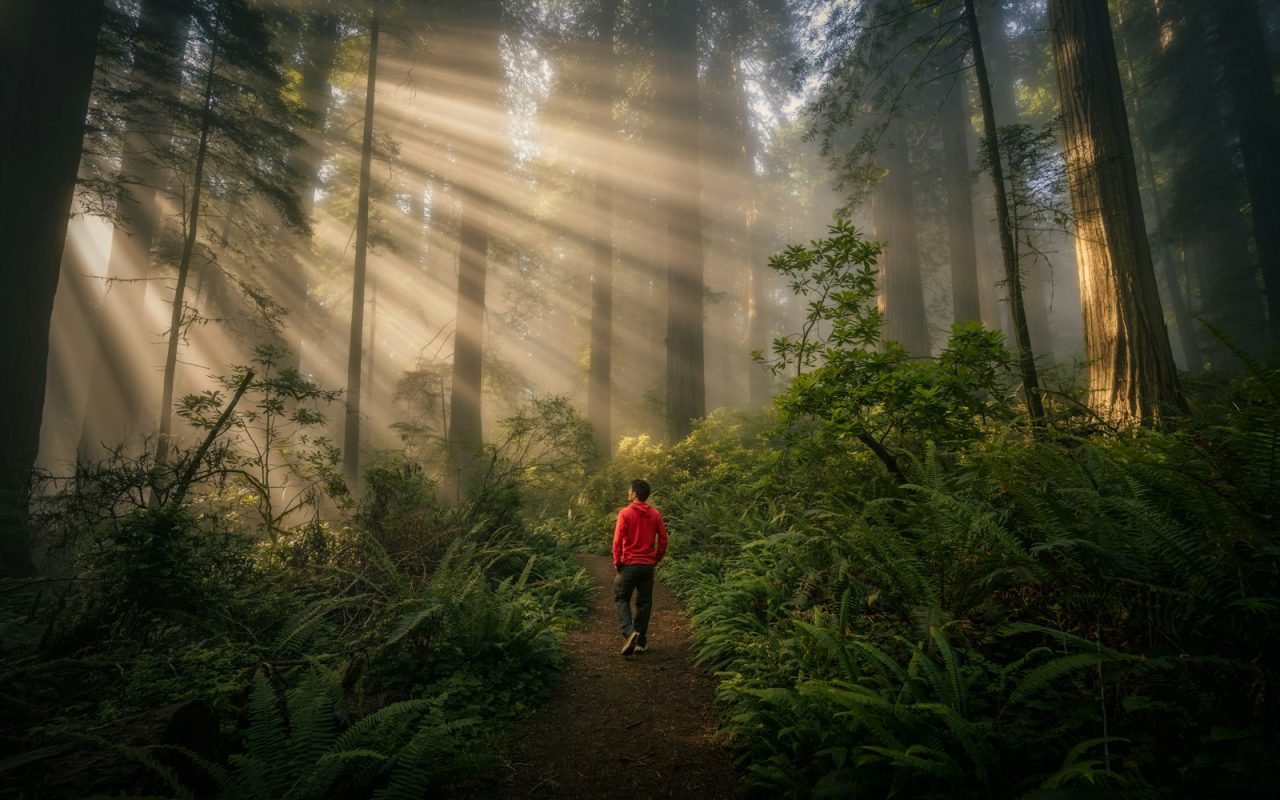
Walk into an old forest after a rain, kneel and scrape away a handful of leaf litter, and you will find a tangle of fine white threads clinging to the soil. They look like cobwebs, but they are alive. Underground, fungi grow around and into tree roots, trading nutrients for sugars. These partnerships are real and ancient. What scientists are still arguing about is a bigger, more poetic question: are these threads a kind of conversation between trees?
A partnership older than forests
The relationship between plants and fungi is one of the oldest alliances in the history of life on land. Fossils suggest that early plants were partnering with fungi more than 400 million years ago, long before the first true trees appeared. Some researchers think plants may never have conquered dry land without fungal help.
The partnership is called a mycorrhiza, from Greek words for fungus and root. The fungus sends out a vast web of microscopic threads, called hyphae, that are far thinner than plant roots. These threads reach into tiny spaces in the soil, gathering water and nutrients such as phosphorus and nitrogen. In return, the plant shares sugars it makes from sunlight. The fungus cannot photosynthesize, so the deal works for both sides.


There are two main styles of partnership. In one, the fungus wraps around the outside of the root and slips between root cells. In the other, the fungus actually pushes into the root cells and forms tiny branching structures where nutrients are exchanged. Different trees prefer different styles. Oaks, pines and birches commonly use the first, while maples and many grasses use the second.
The “wood wide web”
Because a single fungus can attach to more than one plant, and a single tree can host many fungi, the threads can link trees together into what scientists call a common mycorrhizal network. Journalists gave it a catchier name, the “wood wide web,” and the phrase took off.
Some studies suggest these fungal networks can move carbon and signals between trees. In field experiments, researchers have added traceable forms of carbon to one tree and later detected small amounts in neighboring trees connected through the soil. Other experiments have hinted that plants under attack by insects may trigger defensive changes in nearby plants, possibly through fungal connections.
Those findings inspired a wave of popular books, documentaries and articles. Mother trees were said to nurse their seedlings. Forests were described as cooperative communities that share food and send warnings. It is a beautiful image, and it changed how many people look at the woods.
The fungi are definitely there. How much the trees “talk” is the exciting open question.
Dr. Priya Raman, biologist
The debate
Other researchers say the evidence for trees deliberately helping each other is weaker than headlines suggest. In recent years, several scientists have gone back through the published studies and raised concerns. Their points are worth understanding, because they show how science checks itself.
- Connections are hard to prove. It is difficult to show that two mature trees in a real forest are joined by the same continuous fungal network rather than separate ones.
- Other routes exist. Carbon and chemical signals can travel through soil water, roots touching directly or the air, not only through fungi.
- Amounts may be small. In many experiments, the carbon that moved between trees was a tiny share of what the trees use, and it may stay in the fungus rather than reach the neighbor.
- Lab results may not scale up. Effects seen in pots and greenhouses with seedlings do not always appear in large, complex forests.
- Motives are a stretch. Saying a tree “chooses” to help its kin goes well beyond what current measurements can show.
None of this means the original researchers were wrong to explore the idea. It means the evidence is still being gathered, and that some of the most exciting claims got ahead of the data. That is a normal and healthy part of science.
What the fungi might be up to
Some scientists suggest we should think about the network from the fungus’s point of view. A fungus connected to several trees may simply move resources where it benefits the fungus most, like a merchant trading between towns. If a nearby tree happens to receive a little extra, it may be a side effect rather than a gift. Others argue that, whatever the motive, even small transfers could matter for a struggling seedling in deep shade. Both views can be partly true at once.
How the research is done
Studying a network you cannot see is a real challenge. Researchers dig careful trenches, sample root tips and use genetic tests to identify which fungi are attached to which trees. Some teams grow seedlings behind fine mesh barriers that let fungal threads pass but block roots, so they can compare connected and disconnected plants. Others use labeled forms of carbon or nitrogen and track where they end up weeks later. Each method answers part of the question, but none gives the full picture on its own, which is why results from different teams can seem to point in different directions.
What we know for sure
Strip away the headlines and some facts remain solid. Mycorrhizal fungi are essential to the health of most forests. They help trees find water during dry spells and absorb nutrients from poor soils. They help bind soil particles together, reducing erosion. They also store a large amount of carbon underground, which is one reason forest soils matter so much in discussions about climate.
Foresters and gardeners have taken note. Some tree-planting projects now add native soil from healthy forests to help young trees connect with the right fungi. Many gardeners also try to disturb soil less, avoid heavy tilling and leave leaf litter in place, giving fungal threads a chance to grow undisturbed.
If you want to see the partnership for yourself, look for mushrooms near the base of trees after a fall rain. Many of those mushrooms are the fruiting bodies of mycorrhizal fungi, popping up from the hidden network below. Just admire them rather than tasting them. Many wild mushrooms are toxic, and only an expert should ever identify one for eating.
Quick facts
- Most plants partner with fungi
- Fungal threads can stretch long distances
- Good science includes healthy disagreement
That last fact may be the most important. The story of the wood wide web is a reminder that a compelling idea still needs careful testing. Researchers on different sides of the debate are now designing larger, longer field experiments with better tools for tracing what moves through the soil and where it ends up. Over the next decade, we may get much clearer answers.
Listening to the forest
So, do trees talk? The honest answer is that we do not fully know yet. Trees and fungi are unquestionably connected in deep, ancient partnerships that keep forests alive. Whether those connections add up to anything like communication, cooperation or care is still being worked out in labs and forests around the world.
That uncertainty does not make the forest any less wonderful. If anything, it invites us to look closer. The next time you walk under tall trees, remember the living web beneath your feet, and the scientists still kneeling in the dirt, trying to understand what it is really doing.
Key takeaway: the fungal networks under forests are real and vital. The idea that trees deliberately talk and share through them is intriguing, but the science is still being debated.












Thanks for explaining this so clearly.
Great reporting — please keep following this story.