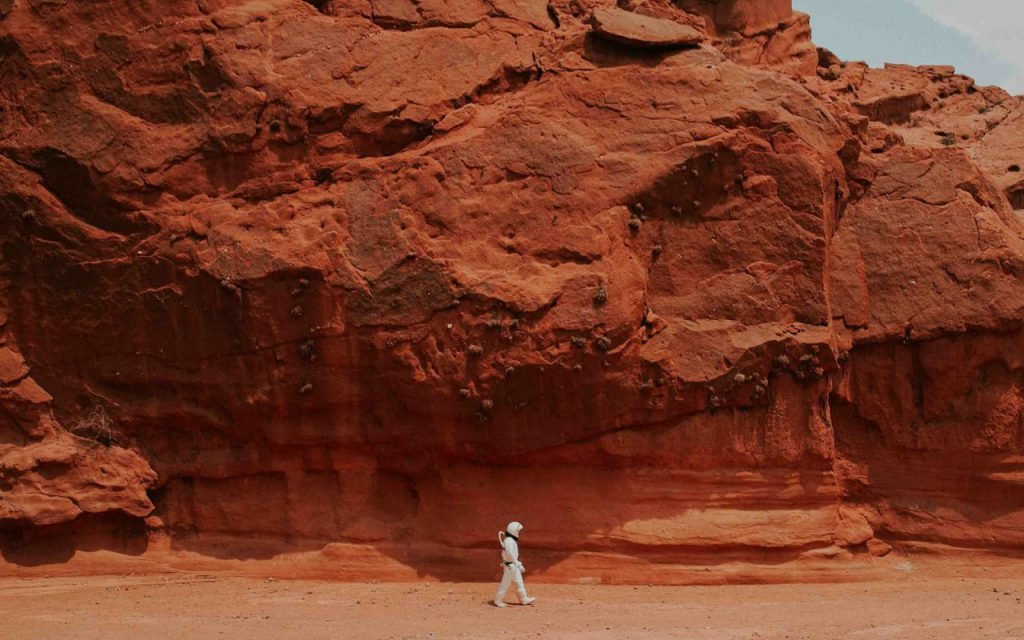
On a clear night when Mars is near Earth, you can spot it without a telescope: a steady, unmistakably orange-red point of light that has caught human attention for thousands of years. Ancient skywatchers linked its fiery color to war and blood. The real explanation is far more down-to-earth, and you have probably seen it on an old bicycle or a forgotten garden tool. Mars looks red because its surface dust is rich in iron oxide — the same compound we call rust.
A rusty planet
Iron is one of the most common elements in the rocky planets, including Earth and Mars. When iron meets oxygen, especially with a little help from water, it oxidizes. On Earth, that reaction turns a shiny nail reddish-brown. On Mars, a similar process has worked on the planet’s iron-rich rocks for billions of years, coating the surface in fine reddish minerals.
Scientists are still sorting out exactly how that rusting happened. Mars has very little oxygen in its thin atmosphere today. Some of the oxidation may have taken place long ago, when the planet was wetter and liquid water could help the chemistry along. Some may come from slow reactions with small amounts of oxygen and other chemicals in the air, aided by ultraviolet sunlight that streams down to the surface without a thick protective atmosphere to block it.


The red color is mostly skin-deep. When rovers scrape or drill into Martian rocks, they often find gray or bluish material just below the surface, the original volcanic rock that has not yet been weathered. Mars is less a red planet than a gray planet with a very dusty, rusty coat.
Dust everywhere
Fine dust coats the whole planet and is lifted into the thin air by winds and huge dust storms. The particles are tiny, finer than flour in many cases, which lets them stay suspended for a long time once they rise. That airborne dust tints the Martian sky a butterscotch or pinkish color during the day.
Mars is famous for its dust storms. Small whirlwinds called dust devils spin across the plains almost every day in some seasons, leaving dark tracks where they lift away the bright surface dust. Larger regional storms can cover areas the size of a continent. Every few Martian years, those storms can merge into a planet-encircling event that hides nearly the entire surface from view for weeks.
Dust is both a nuisance and a clue for explorers. It coats solar panels, slowly reducing the power available to landers and rovers. Several missions have ended or been greatly limited because their panels were buried in dust. On the other hand, studying where dust collects and how storms grow helps scientists understand Martian weather and plan safer missions.
A blue sunset on a red world
Here is one of the most surprising facts about Mars: its sunsets are blue. The fine dust in the air scatters red light in many directions but lets blue light pass more directly along the line of sight near the Sun. So as the Sun sinks toward the horizon, a cool blue glow surrounds it, the opposite of the warm orange sunsets we see on Earth. Rover cameras have captured this effect many times.
Every rover photo is a postcard from a world that used to have lakes.
Dr. Owen Hale, geologist
A wetter past
Rovers have found dried riverbeds, lake deposits and minerals that form in water, so Mars was once much wetter. From orbit, spacecraft have photographed branching valley networks that look a lot like river systems on Earth, as well as fan-shaped deltas where those rivers once emptied into standing water.
On the ground, rovers have studied layered rocks that formed at the bottom of ancient lakes. They have found rounded pebbles, smoothed the way stream stones are on Earth, and clay minerals that typically form when rock sits in water for long periods. Some rocks contain veins of minerals left behind as water seeped through cracks and evaporated.
Billions of years ago, Mars likely had a thicker atmosphere that could keep water liquid at the surface. Over time, the planet lost much of that atmosphere to space, partly because Mars is small and lost its global magnetic field early, leaving its air exposed to the steady stream of particles from the Sun. As the atmosphere thinned, the planet grew colder and drier. Today, water exists mostly as ice in the polar caps and below the surface, with only fleeting traces of liquid possible under special conditions.
Why water matters so much
On Earth, nearly everywhere there is liquid water, there is life. That is why scientists get so excited about signs of ancient lakes and rivers on Mars. If microscopic life ever arose there, those wet environments would have been the best places for it. Recent rover missions have been collecting carefully chosen rock samples from an ancient lake bed, with the long-term goal of returning them to Earth for study in advanced laboratories.
Seeing Mars from your backyard
You do not need a spacecraft to enjoy Mars. Here are a few tips for spotting the red planet yourself:
- Check when it is visible. Mars is best seen around “opposition,” when Earth passes between Mars and the Sun. This happens about every 26 months, and the planet is brightest and visible all night.
- Look for the color. Mars shines with a steady orange-red glow and twinkles less than nearby stars.
- Use a telescope for detail. Near opposition, a small telescope can show a bright polar ice cap and darker surface markings.
- Be patient with the air. Mars is small in the eyepiece, so wait for moments of steady air when details snap into focus.
- Watch for storms. If a global dust storm is underway, surface features may fade into a uniform orange haze.
A free planetarium app or a sky-events calendar can tell you where to look on any given night. Local astronomy clubs often host public nights around oppositions, which are a great chance to see Mars through a larger telescope.
Quick facts
- Surface dust is rich in iron oxide
- A Mars day is about 24 hours 37 minutes
- Mars has two small moons: Phobos and Deimos
That day length is remarkably close to our own, which is one reason mission teams who work on “Mars time” can adapt, at least for a while. Each day their schedules slide about 40 minutes later, so meetings eventually drift into the middle of the night. A Martian year, however, is much longer, lasting about 687 Earth days. Mars’s two moons are tiny and lumpy, more like potatoes than spheres. Phobos, the larger one, orbits so close that it circles the planet three times in a single Martian day.
The color of history
Mars’s famous red is more than a pretty color. It is a record of chemistry, weather and time. The rust tells us about iron and oxygen interacting over billions of years. The dust tells us about a restless atmosphere that still whips up storms across the planet. And the hidden layers beneath the dust tell us about a world that once had rivers, lakes and perhaps the conditions for life.
Every new rover image adds another chapter to that story. Look up the next time Mars rises over the horizon, and remember that its glow is the color of a planet still revealing its past.
Key takeaway: Mars is red because its surface is covered in iron-rich dust that has rusted over billions of years, spread around the planet by winds and dust storms.