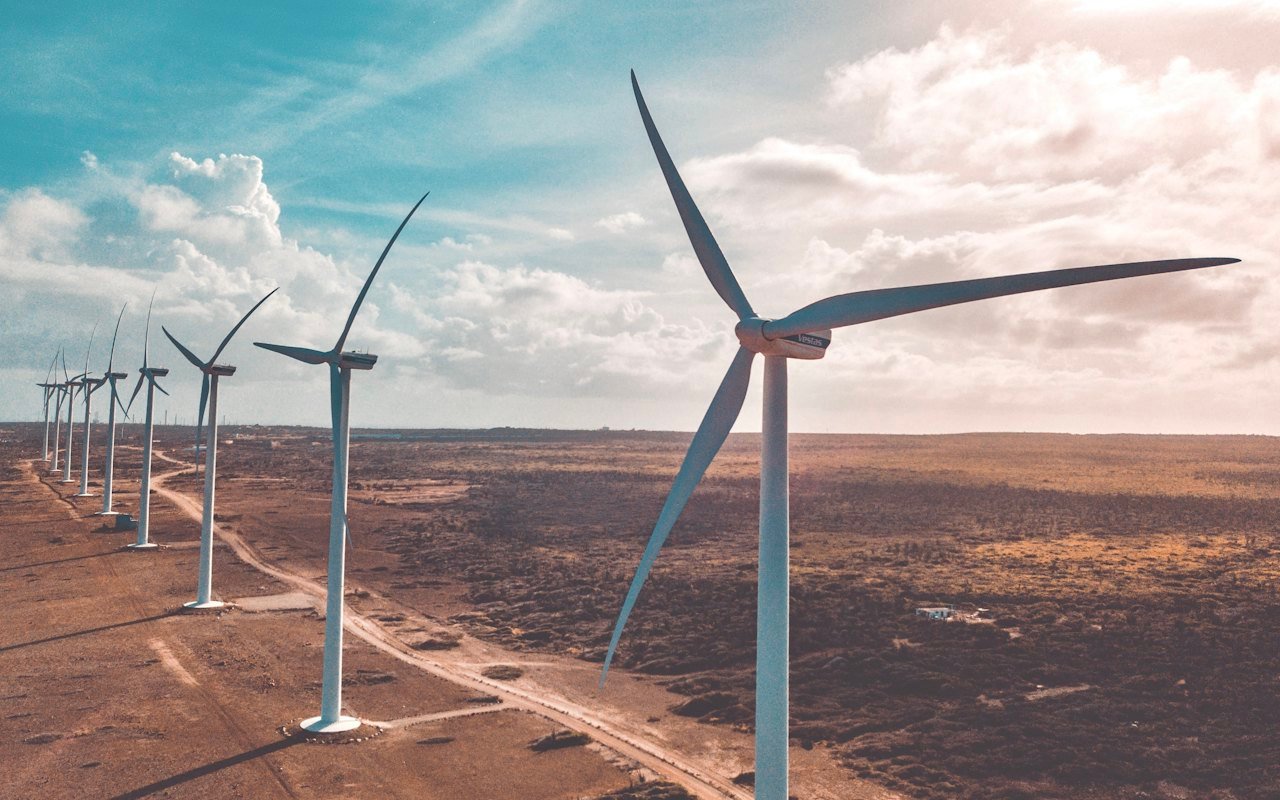

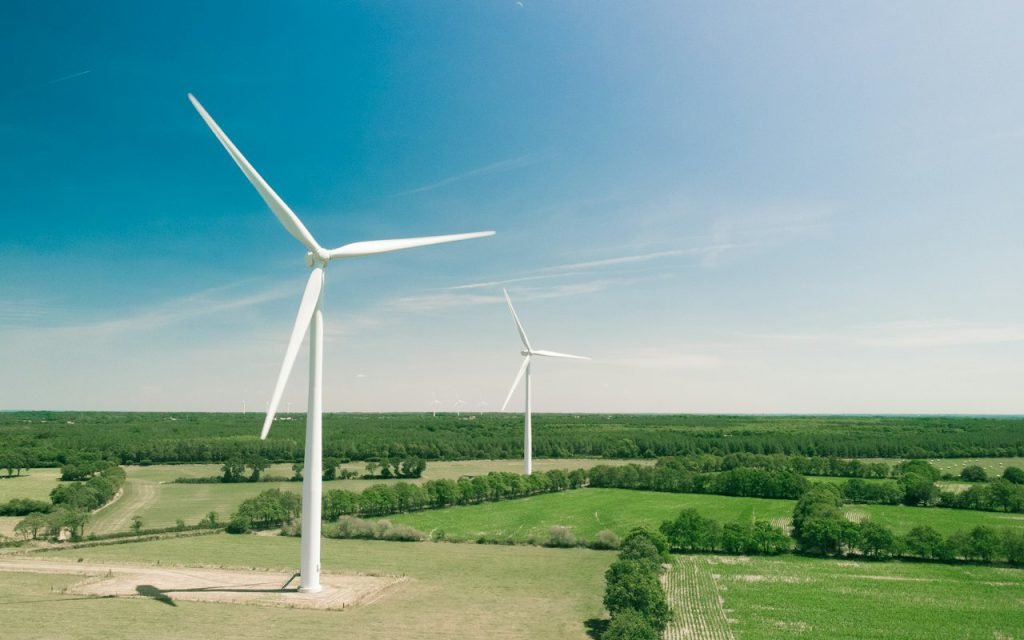
Drive across the plains of Kansas, the hills of central California or the open ranchland of west Texas, and you will eventually see them: rows of tall white towers with three slender blades turning slowly against the sky. Up close, they are enormous, and they make a soft, rhythmic whoosh. A modern wind turbine works like a fan in reverse: wind spins the blades, and a generator turns that motion into electricity. The idea is simple. The engineering behind it is anything but.
How a blade catches the wind
A turbine blade is not a flat paddle that the wind simply pushes. It is shaped much like an airplane wing, with a curved surface on one side and a flatter surface on the other. As air flows over the blade, the shape creates a difference in pressure between the two sides. That pressure difference produces lift, the same force that keeps an airplane in the air, and lift is what pulls the blade around the hub.
Blades are also twisted along their length. The tip of a long blade moves much faster than the root near the hub, so each section meets the wind at a slightly different angle. The twist keeps every part of the blade working efficiently. Modern blades are made from lightweight composite materials such as fiberglass and resin, strong enough to bend in gusts without breaking.


Most large turbines have three blades. Engineers have found that three strikes a good balance: more blades would add weight and cost without much extra power, while fewer blades tend to spin less smoothly and wobble more.
Inside the nacelle
At the top of the tower sits a large housing called the nacelle, roughly the size of a bus on big turbines. This is where the real machinery lives. The rotor, made up of the hub and blades, turns a main shaft. In many turbines, that shaft feeds into a gearbox, which converts the slow, powerful rotation of the blades into the much faster spinning a generator needs.
Some newer designs skip the gearbox altogether. These direct-drive turbines use very large generators that can produce electricity from slower rotation. They have fewer moving parts, which can mean less maintenance, a big advantage when the machine is hundreds of feet in the air or miles out at sea.
The nacelle also holds sensors, brakes, cooling systems and a computer that constantly monitors conditions. Electricity from the generator travels down cables inside the tower, passes through equipment that adjusts its voltage and joins the wider power grid.
Turning to face the wind
Wind does not always blow from the same direction, so turbines have to follow it. A small weather station on top of the nacelle measures wind speed and direction. When the wind shifts, motors slowly rotate the entire nacelle and rotor to face it, a process called yawing. Meanwhile, the angle of each blade can be adjusted, or pitched, to capture the right amount of energy and protect the machine in strong gusts.
Why so tall
Winds are stronger and steadier higher up, and longer blades sweep a much bigger area. Close to the ground, trees, hills and buildings slow the air and make it turbulent. A few hundred feet up, the wind flows more smoothly and usually blows harder. That is why modern turbine towers are so tall, often taller than a 30-story building when you include the blades.
Blade length matters even more. The amount of energy a turbine can capture depends on the area its blades sweep, which is a circle. Because the area of a circle grows with the square of its radius, a modest increase in blade length produces a large increase in swept area.
Doubling the blade length roughly quadruples the area the turbine sweeps.
Dr. Ethan Brooks, physicist
Wind speed has an even bigger effect. The power available in wind rises with the cube of its speed. In plain terms, if the wind blows twice as fast, it carries about eight times as much energy. That is why developers spend months, sometimes years, measuring wind at a site before building. A location with just slightly stronger average winds can produce much more electricity over the life of a turbine.
Out at sea
Offshore turbines catch strong, steady ocean winds and can be even larger. Over open water, there are no hills or forests to slow the air, so winds tend to be faster and more consistent. Offshore projects can also be built closer to coastal cities, where demand for electricity is high, without taking up land.
Building at sea is a major challenge, though. In shallower water, turbines stand on foundations driven into the seabed. In deeper water, engineers are developing floating turbines anchored to the ocean floor with cables, an approach that could open up vast new areas off coasts such as California and Maine. Offshore turbines must survive salt spray, waves and storms, and maintenance crews often need boats or helicopters to reach them.
Wind on the grid
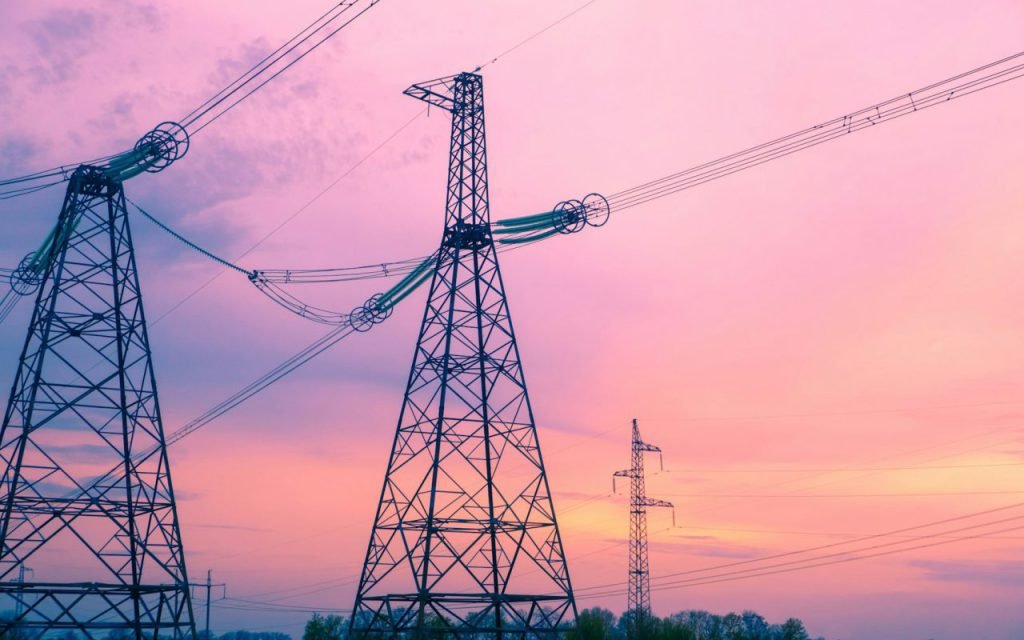
Because the wind rises and falls, wind power does not arrive at a perfectly steady rate. Grid operators handle this by blending many sources of electricity and using increasingly accurate weather forecasts to predict how much wind power will be available hours or days ahead. Spreading turbines across large regions helps, since the wind is rarely calm everywhere at once. Batteries and other forms of storage are also playing a growing role, soaking up extra power on windy nights and releasing it when demand peaks.
Wind turbines also have neighbors to consider. Developers study bird and bat migration routes, noise and views before choosing sites, and some projects pause turbines during peak migration periods. Communities often weigh these concerns alongside benefits such as lease payments to landowners and local jobs. Like any energy source, wind involves trade-offs that local governments and residents discuss together.
Life of a turbine
A typical modern turbine is designed to run for 20 to 30 years. Technicians climb the towers regularly for inspections, often using internal ladders or small elevators, wearing safety harnesses the whole way up. Older turbines are sometimes “repowered,” replacing blades and nacelles with newer, more efficient parts while reusing the site and its connections to the grid. Researchers are also working on better ways to recycle old blades, which are tough to break down.
Quick facts
- Power rises steeply with wind speed
- Turbines turn to face the wind automatically
- They shut down in very high winds for safety
That last point surprises many people. In a fierce storm, turbines do not spin faster and faster. When winds pass a set limit, the control system pitches the blades so they slice through the air without catching it and applies brakes to stop the rotor. The machine waits out the storm and starts again once the winds ease.
A simple idea, scaled up
People have harnessed the wind for centuries, from sailboats to the windmills that once pumped water across American farms. Today’s turbines take that ancient idea and scale it up with modern materials, aerodynamics and computer control. The result is a machine that quietly turns moving air into electricity for homes, schools and businesses.
Key takeaway: a wind turbine uses wing-shaped blades to turn moving air into rotation, and a generator turns that rotation into power. Taller towers and longer blades let it catch far more energy from the wind.