The high school robotics team qualified for the national championship for the first time, after winning the New England regional. Twelve students, two volunteer coaches and one very fast robot named Maple will travel to Houston in the spring to compete against teams from across the country. The win, sealed in a tense final round at the regional championship in Massachusetts earlier this month, caps a remarkable rise for a team that was founded just four years ago with a handful of members and a borrowed toolbox. Now the students are trying to raise the money to get there, and the community is starting to rally behind them.
Meet Maple
The team’s robot stacks cubes faster than any other at regionals, thanks to a gripper designed by a sophomore. This year’s competition challenge asked teams to build robots that could pick up foam cubes, stack them on scoring platforms and then climb a low bar in the final seconds of each match. Points are awarded for height, speed and a successful climb.
Maple stands a little under three feet tall and weighs about 110 pounds. Its most distinctive feature is a two-finger gripper that closes around a cube from the side rather than scooping from below, which lets the robot grab and release cubes in a fraction of the time it takes most competitors. The design came from sophomore Eli Navarro, who sketched the first version in a notebook during study hall.


“I kept watching videos of our old robot fumbling cubes, and I thought, what if it just pinched them like fingers?” Navarro said. “We built maybe nine versions before it worked. The first ones kept dropping everything.”
Built from scrap and stubbornness
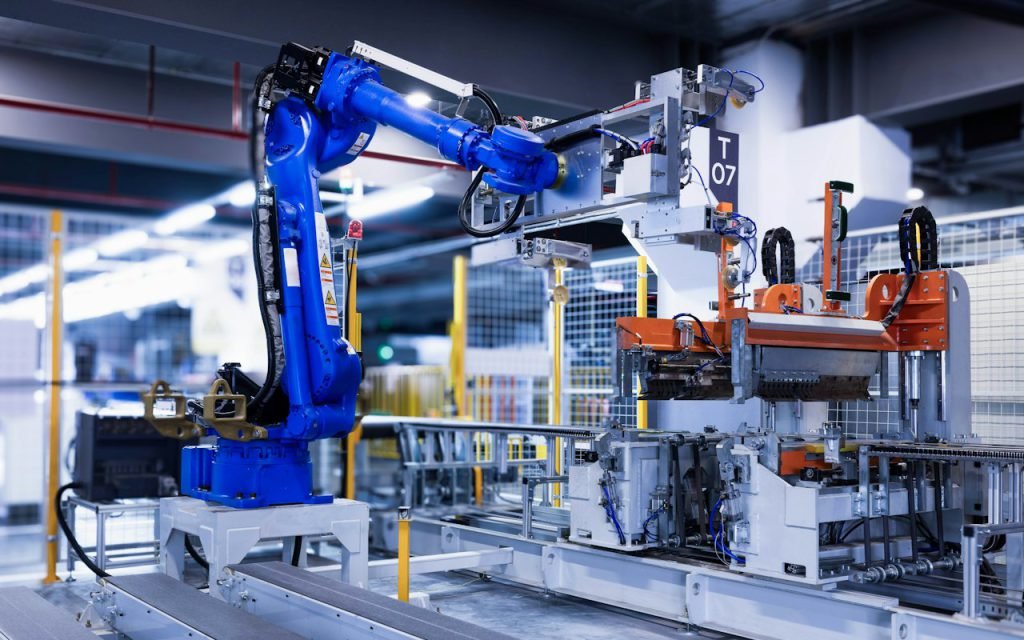
The team operates on a tight budget, and much of Maple was built from salvaged and donated parts. Students pulled motors, gears and aluminum from old equipment, bought used parts from other teams and machined custom pieces in the school’s shop class after hours.
We built half of this robot out of a broken lawn mower. That’s Vermont engineering.
Ava Chen, team captain
Chen, a senior who has been on the team since its first season, said the lawn mower came from a coach’s neighbor. Its wheels, drive belt and part of its frame ended up in Maple’s base. “People laugh when we tell them,” she said. “But it’s strong, it’s cheap and it works. That’s what matters.”
The team meets four afternoons a week in a converted storage room next to the school’s shop, and more often in the weeks before competitions. Students are organized into subteams for design, mechanical, electrical, programming and outreach, and many move between them over a season.
The people behind the robot
The twelve members range from freshmen to seniors. About half had never built anything mechanical before joining. The team is coached by physics teacher Daniel Okafor and Rachel Stein, a mechanical engineer who volunteers her evenings. Both say the students do the real work.
“Our job is to ask good questions and keep everyone safe in the shop,” Okafor said. “The ideas, the code, the late nights fixing a broken chain at a competition, that’s all them.”
How they won regionals
The regional championship brought together several dozen teams from across New England. Teams compete in a series of qualifying matches, often in randomly assigned alliances with other schools, before the top performers form alliances for the playoff rounds.
Maple finished the qualifying rounds ranked third, and the team was invited to join an alliance with two strong teams from Connecticut and Maine. In the final best-of-three series, the alliance lost the first match after a wheel came loose, then won the next two. The deciding match came down to the last five seconds, when Maple completed its climb just before the buzzer.

Junior Priya Shah, who leads programming, said the team rewrote part of the climbing code in the pits between matches after noticing the robot was hesitating at the bar. “We had maybe twenty minutes,” she said. “We tested it once in the practice area, crossed our fingers and sent it out. It worked.”
More than a competition
Team members and parents say the program has given students far more than a trophy. Robotics combines engineering, programming, design, budgeting, teamwork and public speaking, since students must present their robot and their process to judges at each event.
Several members say the team has shaped their plans after graduation. Chen hopes to study mechanical engineering. Others are considering computer science, electrical engineering or skilled trades such as machining and welding. Okafor said the team has also become a place where students who did not feel at home in sports or other clubs found a group of friends.
Parents have noticed the change too. Linda Navarro, Eli’s mother, said her son used to spend most evenings on video games. “Now he comes home talking about torque and gear ratios,” she said. “I don’t always understand it, but I love hearing it.”
The team also volunteers in the community. Members run free robotics workshops for middle school students at the public library, and they brought Maple to several elementary schools last spring to show younger children how robots work.
Help them get there
The team is raising $9,000 for travel to Houston. The money will cover airfare for students and coaches, shipping the robot, hotel rooms, registration fees and spare parts. Families are covering some of their own costs, but the team says it wants to make sure no student has to stay home because of money.
So far, the team has raised a little over $3,000 through a bake sale, a car wash and small donations. Here is how residents and local businesses can help:
- Donate through the team’s online fundraising page, linked from the high school’s website
- Attend a pancake breakfast fundraiser in the school cafeteria next month
- Sponsor the team as a local business and have your logo on the robot and team shirts
- Donate frequent flyer miles or hotel points through the booster club
- Offer skills or materials, such as machining, welding or spare electronics
Donations are handled by the school’s booster club, a registered nonprofit, and contributions may be tax-deductible. Anyone with questions about donating can contact the club through the school’s main office.
Key takeaway: Twelve students and a robot named Maple qualified for nationals for the first time. They need about $6,000 more to cover the trip to Houston.
Looking ahead to Houston
Between now and the national championship, the team plans to keep improving Maple. Students are working on a lighter frame, a faster climbing mechanism and a backup gripper in case the original breaks. They are also practicing their presentation for the judges and running mock matches against a practice robot built from spare parts.
The school has also arranged for the team to show Maple at a public demonstration in the gym before the trip, so residents can see the robot in action and meet the students who built it.
Chen said the team knows it will face more experienced programs with far bigger budgets. That does not seem to worry her. “We’re a small team from a small city with a robot made from a lawn mower,” she said. “We already proved we belong. Now we get to show the whole country what we can do.”